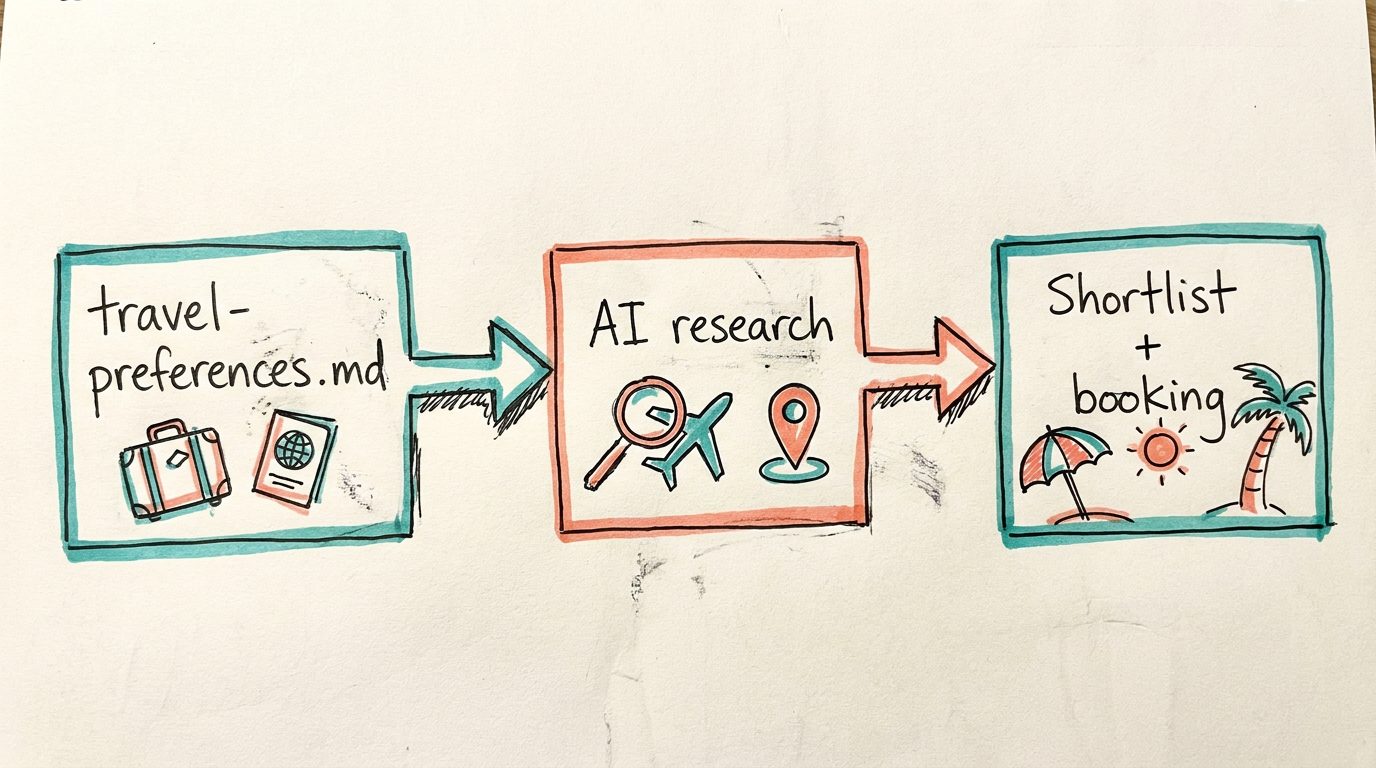
I use Claude among other AI systems for a lot of my daily work and research. I wondered if there was a good way to integrate some of the flows that I use into other tasks in my life. One example of this was in how I booked a family holiday.
Generally for booking and researching, this involves some set of requirements based on who we are and how we like to travel and where we’re based and things like that. And these requirements apply at kind of a general level, so they will apply to all trips that we go on as a family. And then on top of that, there’s some specific requirements (for this trip) which are where do we want to go or what do we want to do on this specific holiday.
And the typical way that we go about doing this is: first, there’s a sort of research phase of looking at different destinations or places. And then agreeing on, okay, this looks like a fun place to go. And once we’re set on the rough kind of holiday or the rough destination we have, then it’s a case of can we get there? How do we get there? And once we’re there, where do we stay and what do we do? And I think there are bits of this that can be optimised and answered using LLMs.
This is not a perfect way of doing it, by any stretch of the imagination. But this is a way that worked for me on a recent trip booking, and so I wanted to share it to see if it works for you too. Over time I will probably optimise this further.
Step 1. Generate general preferences
I asked a model to ask me about the general family travel preferences (that should apply to all/most holidays) and generate me a file that contains all of these in an easy to understand format (for an agent/AI) (I used the prompt below for this)
I want you to help me create a markdown file that captures my household's travel
preferences. The file's audience is an AI agent that will use it to select and book
flights, accommodation, and holidays on my behalf — so it needs to be structured,
unambiguous, and machine-parseable, not a prose essay.

Process:
1. First, ask me to give you free-form background about my household and how we
   like to travel. Don't ask structured questions yet — let me dump context.
2. Then, based on what I've told you, ask me follow-up questions to fill the gaps.
   Ask them in batches of 3–4 as multiple-choice or ranked options wherever possible
   so I can answer quickly. Only ask open questions where multiple choice genuinely
   won't work. Don't ask me things I've already answered in my background dump.
3. When you have a complete picture, write the markdown file.

Areas to make sure you cover (skip any that clearly don't apply to me):
- Household composition: number of adults, children and their dates of birth (not
  ages — ages change), anyone with mobility, dietary or medical needs, pets.
- Home base and departure airports, plus how we get to the airport.
- Flights: cabin class, acceptable departure and arrival times, tolerance for
  connections, minimum layover, any airports or countries to avoid transiting,
  airline loyalty or quality preferences, baggage needs.
- Ground transport: whether we rent cars, and any friction around that (car seats,
  licences, driving on the other side). Acceptable airport-to-accommodation transfer.
- Accommodation: room/bed configuration, hotel vs apartment vs rental, board basis
  (all-inclusive / breakfast / self-catering) and the conditions under which each
  makes sense, amenities that genuinely matter, property types or brands to avoid.
- Differences by trip type (e.g. beach/resort vs city break vs road trip).
- Destination priorities: ask me to rank what draws us to a place.
- Climate and season constraints.
- Budget posture: where we sit on the price-vs-convenience spectrum.
- Booking flexibility: how much we value free cancellation vs a lower price.
- Anything else my background suggests is relevant.

Formatting rules for the file you produce:
- Open with a short "Purpose" note telling the reading agent how to interpret the file.
- Clearly distinguish HARD CONSTRAINTS (never violate without flagging) from
  PREFERENCES (optimise for, but tradeable against price and convenience).
- Store children's dates of birth, and explicitly instruct the agent to recompute
  ages at time of travel — including checking whether a child crosses an age
  threshold (e.g. lap infant to own seat) between outbound and return.
- Use headed sections with bullets. Include a quick-reference summary table at the end.
- Where I've expressed a conditional rule, preserve the condition rather than
  flattening it into an absolute.
- Note any preferences likely to go stale (children's ages, budget) so I know what
  to revisit.

Ask me for my background now.
This generated a markdown file, And hopefully this is the file that you can use for future trips and gradually improve on in the future. It basically holds all of your family’s or your personal preferences of how you like to travel and it’s the kind of thing you might communicate to someone who is booking a trip for you.
2. Create a project repo
I created a new Claude Code project on my computer and placed this generated preferences file in there. I called the project travel.
3. Give it a specific holiday query
I started a new chat in this repo for a specific holiday query.
This is exactly what I asked for:
We want to book a roughly week long family holiday in October 2026 to a warm location, preferably with a beach nearby. We're thinking of resort style places in Greece, Cyprus, but are not fully limited to there. We don't want horrible mass market all inclusive resorts where each day is the last day on repeat when it comes to buffets and food, but we do want some pools and fun activities for kids. Help me narrow down some choices and ideas. Take a look at the travel-preferences.md file for our preferences. The kids' preschool is closed 16th October so would be great if it includes that date.
It went away. Did a bunch of searches.It was really neat to see it on Google Flights doing searches and checking out our websites and looking at reviews and browsing to lots of different things.
This is what it came back with:
Here’s a narrowed-down shortlist. The single biggest decision is which week of October, because it splits the map in two: in early October (weeks 1–2) the Greek islands are still lovely (~24–26°C, warm sea) with direct flights running; by late October Greek season winds down, seasonal ARN routes end, and weather gets iffy — while Cyprus (~26–28°C), Antalya (~26–28°C) and the Canaries (~26°C, most reliable of all) stay solidly warm. Since your eldest is only 4, you’re not tied to höstlov, so aim for the first half of October and everything below is in play.
It identified that the timings for some of the places wasn’t great because it was too end of season and summarised it by checking flights:
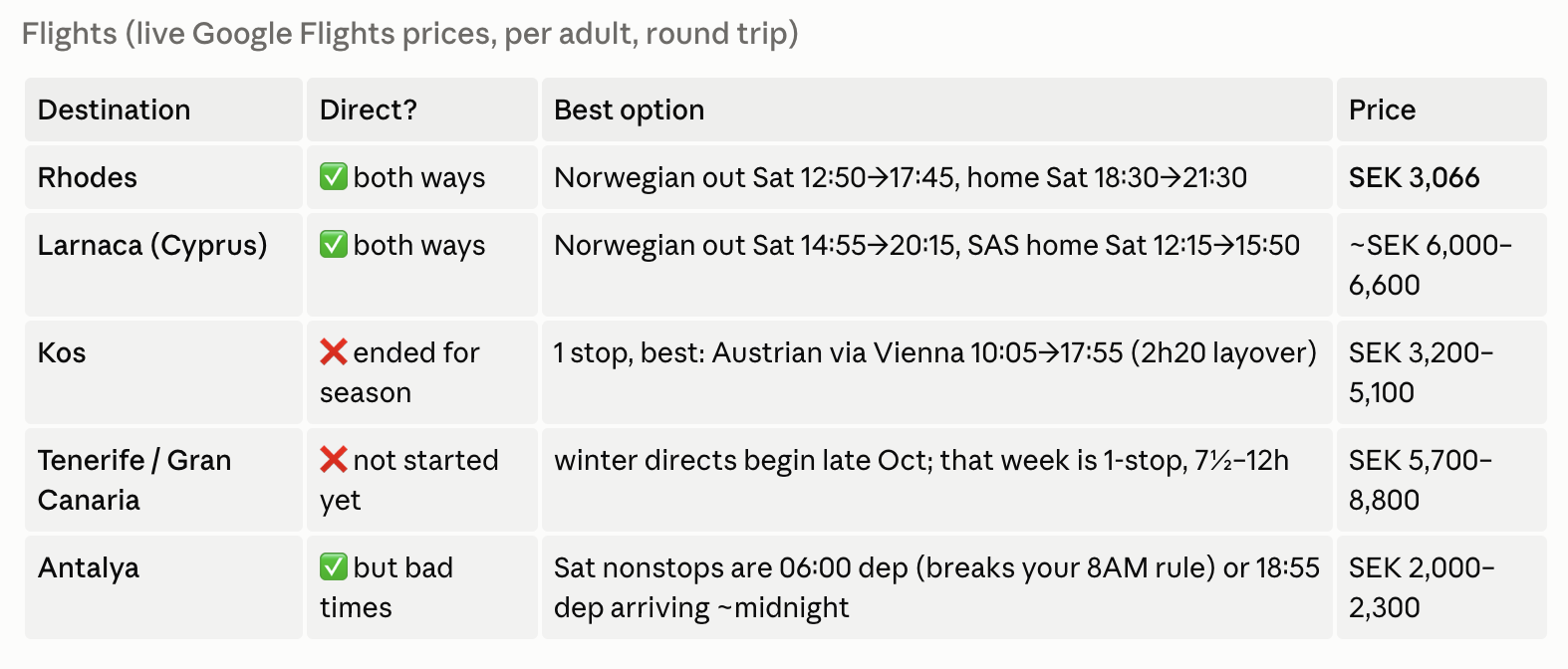
Along with a shortlist and some examples, reasoning on why we should pick different ones, and why certain other options that we might have wanted didn’t work.
We were then able to ask specific questions about different resorts. Obviously you want to check that it is pulling from relevant data, but in my cases I checked and it was pulling from the actual resort website and some reviews of said resort.
All in all it was really great at doing a lot of the boring planning work of deciding how to get there and what options were completely off of the table because things like flights didn’t work. Well, it’s not going to completely replace your whole holiday booking process……yet. But it will definitely do some of the heavy lifting if you wanted it to.
Give it a go and let me know how you get on!